Product Vision & Experience Strategy · 2026
Designing Experian's Future Member Experience
Reimagining how people build a relationship with Experian — moving from a set of disconnected credit features to a continuous, supportive financial companion.
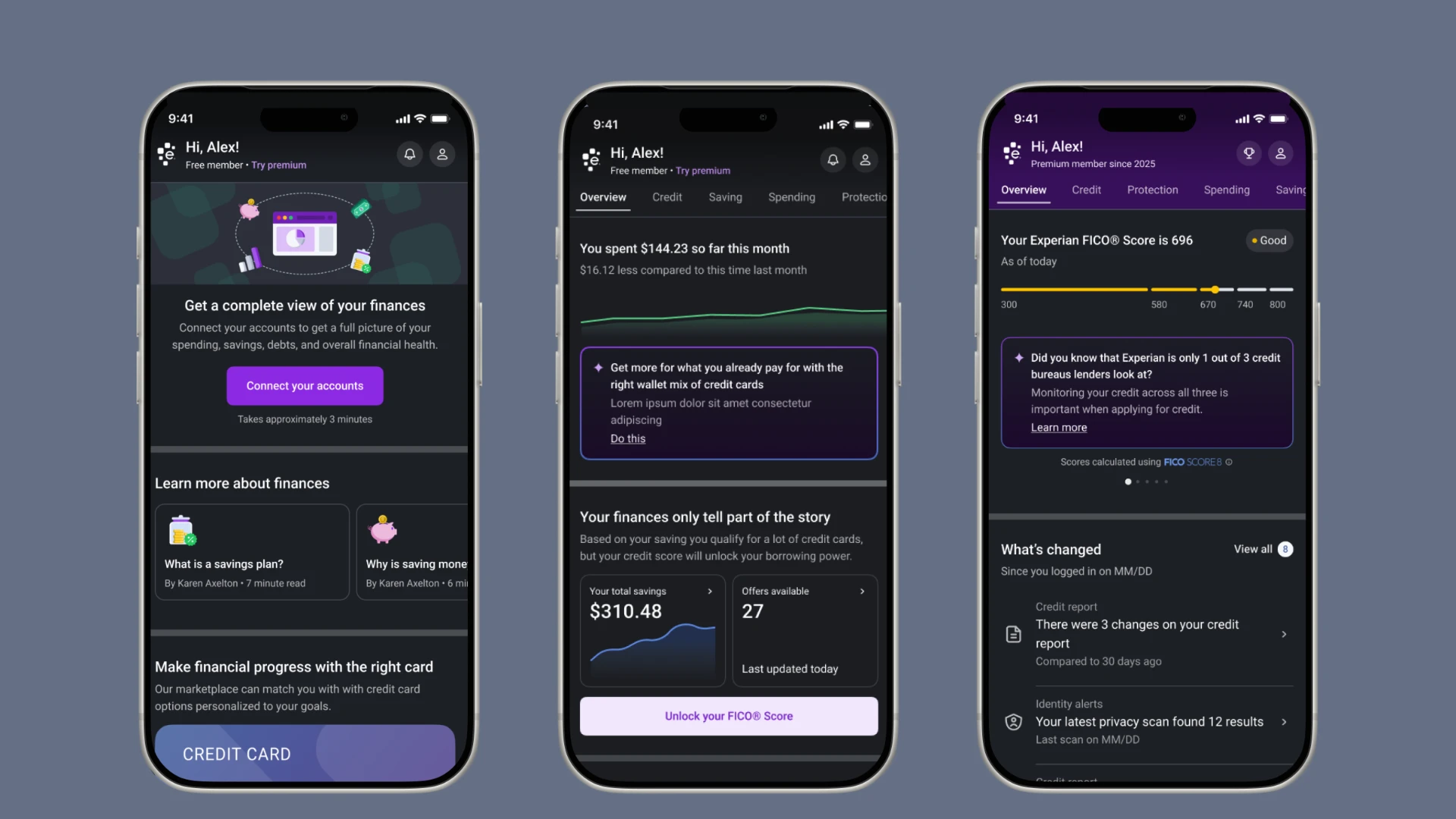
- Role
- Lead Product Designer
- Year
- 2026
- Focus
- Product Vision • Product Design • Experience Strategy • Cross functional collaboration • AI Prototyping
- Team
- Design, Research, Engineering
The challenge
Experian wanted to build a more durable, habit-driven member experience that encouraged people to return because they found ongoing value. To do so, they wanted to evolve beyond their role as a credit bureau and into a trusted financial partner.
Rather than redesigning individual features, I reimagined the end-to-end member experience–connecting onboarding, personalization, financial health, AI and product strategy into a single experience model that continues to influence the product roadmap.
My role
As the Lead Product Designer within DX Labs, I led the initiative from initial framing through future-state vision.
Responsibilities:
- Defining and continually reframing the problem
- Mapping the end-to-end member journey
- Synthesizing previous strategic initiatives into one cohesive experience model
- Facilitating cross-functional workshops
- Building interactive prototypes to explore evolving member states
- Partnering with Product, Engineering, Research, Credit, Financial Health, and Experience Orchestration
- Creating presentations, documentation, and recorded walkthroughs that built alignment across the organization
My role wasn't simply to design a future experience. It was to create enough shared understanding that the organization could collectively shape that future.
My Approach
I started by zooming out. Instead of designing a homepage, I mapped the complete member journey—from the moment someone creates an account through becoming a deeply engaged member.
For every stage of the relationship, I asked:
- What is this person trying to accomplish?
- What do we know about them today?
- What value can we provide with that knowledge?
- What trust have we earned?
- What information is appropriate to ask for next?
- How should the experience evolve as we learn more?
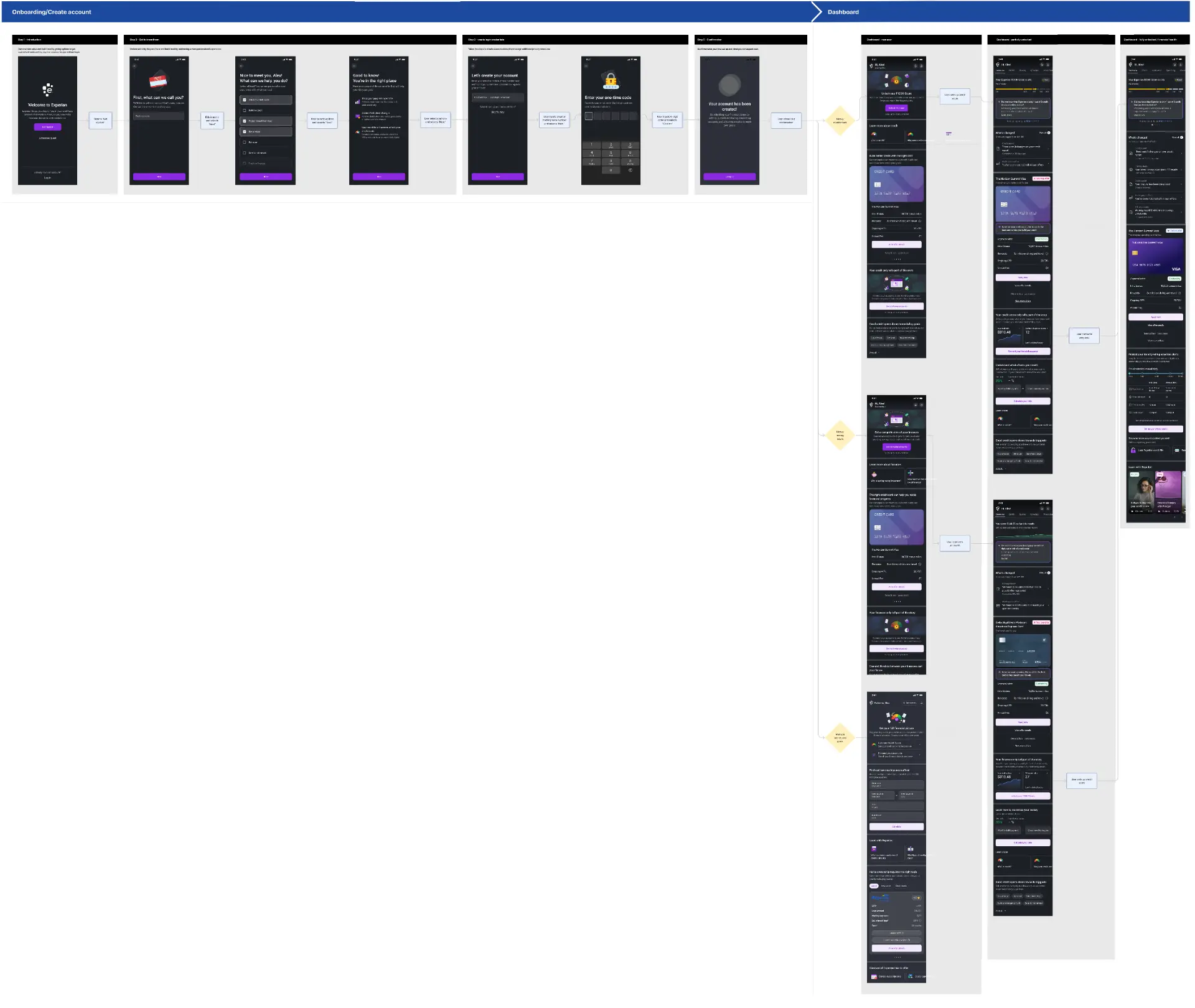
Exploring how we could deliver value from day one, then deepen the experience as we learn more about each member.
“People don't experience products in features or pages. They experience one continuous relationship with a company.”
Connecting Disconnected Ideas
As the work progressed, I recognized that several strategic initiatives already happening across the organization weren't independent efforts—they were different pieces of the same member experience.
These included:
- 1
Progressive onboarding
Explored how to reduce barriers to entry while demonstrating the value of sharing personal data through progressively more personalized insights and experiences.
- 2
Financial health
Evolving Experian beyond credit into a personalized financial co-pilot that turns data into actionable guidance and goal tracking.
- 3
AI-powered personalization
Exploring AI-powered capabilities to create a more personalized and proactive financial experience.
- 4
Premium
Exploring an elevated premium experience that makes membership value more visible and meaningful.
- 5
Dashboard evolution
Reimagining the homepage through experimentation to create a more relevant and engaging member experience.
- 6
IA redesign
Reimagining the information architecture around customer mental models to create a more intuitive and discoverable product ecosystem.
Rather than treating each initiative as its own project, I developed a single experience model that showed how they could work together throughout the member lifecycle.
The work shifted from designing features to designing the system connecting them.
Designing the Relationship
One of the biggest insights emerged while exploring onboarding. Originally, we focused on reducing friction during registration. But through iterative prototyping, another opportunity surfaced.
Instead of asking people to complete setup before receiving value, the experience itself could progressively earn trust.
Experience value → Build trust
Share context → Unlock more
Receive greater personalization
Rather than configuring the product up front, members would progressively shape their experience over time as they chose to share more context. The product itself became onboarding.
A New Role for the Dashboard
One workshop fundamentally changed the direction of the project. Working alongside leaders from Design, Credit, and Financial Health, we reframed the homepage entirely. Instead of asking “Where should Financial Health live?” we asked “What is the purpose of the homepage?”
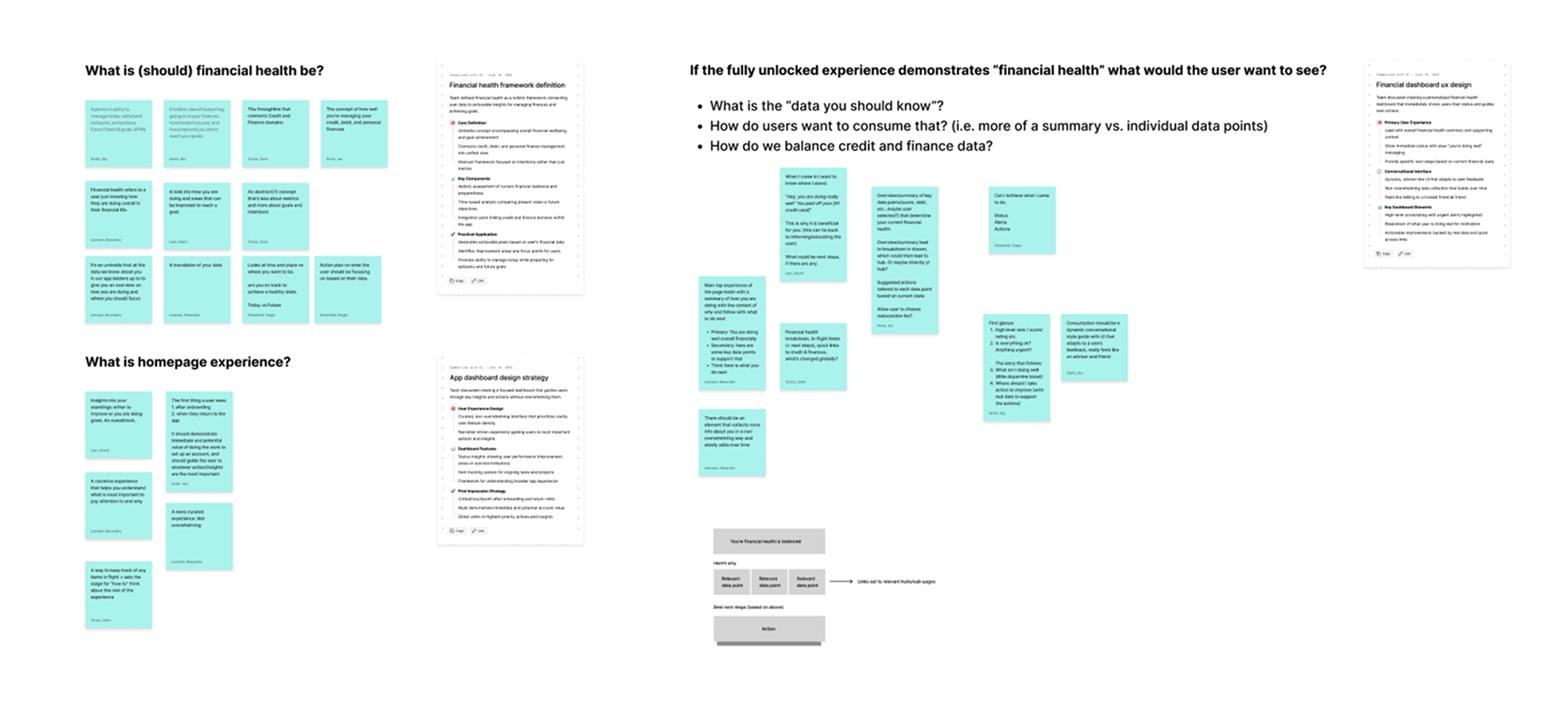
We realized that Credit, Goals, Spending, Identity, and Financial Health weren't competing destinations. They were all inputs into a much larger question:
- How am I doing?
- What changed?
- What deserves my attention?
- What should I do next?
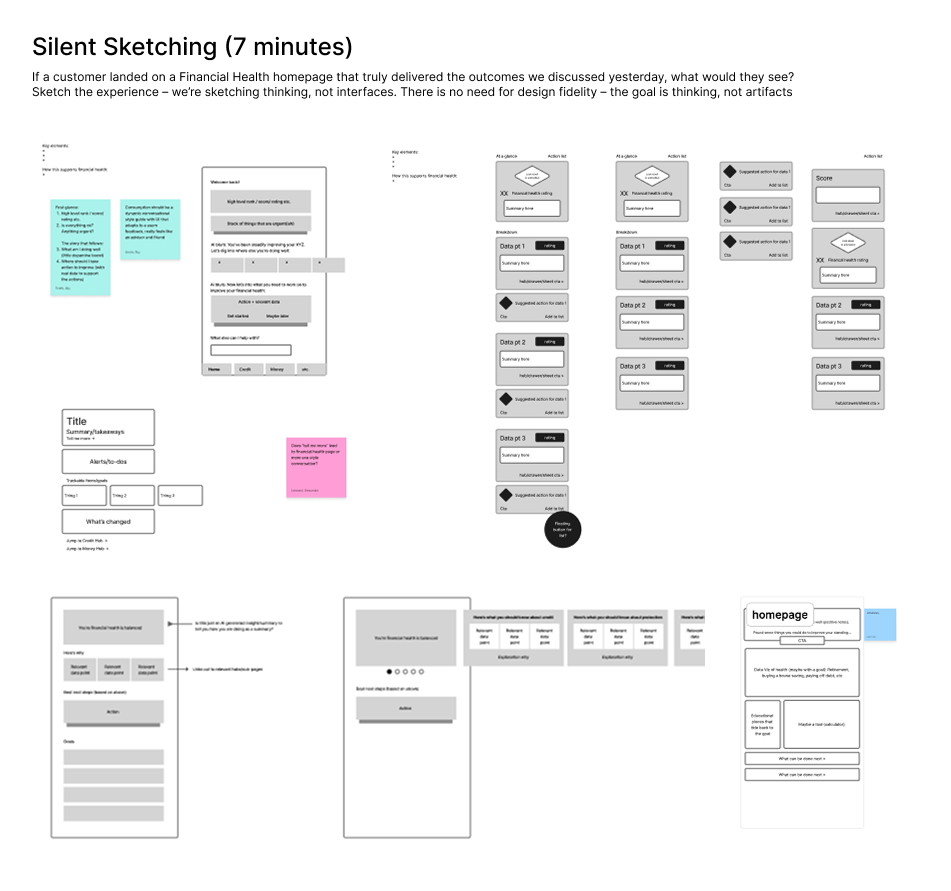
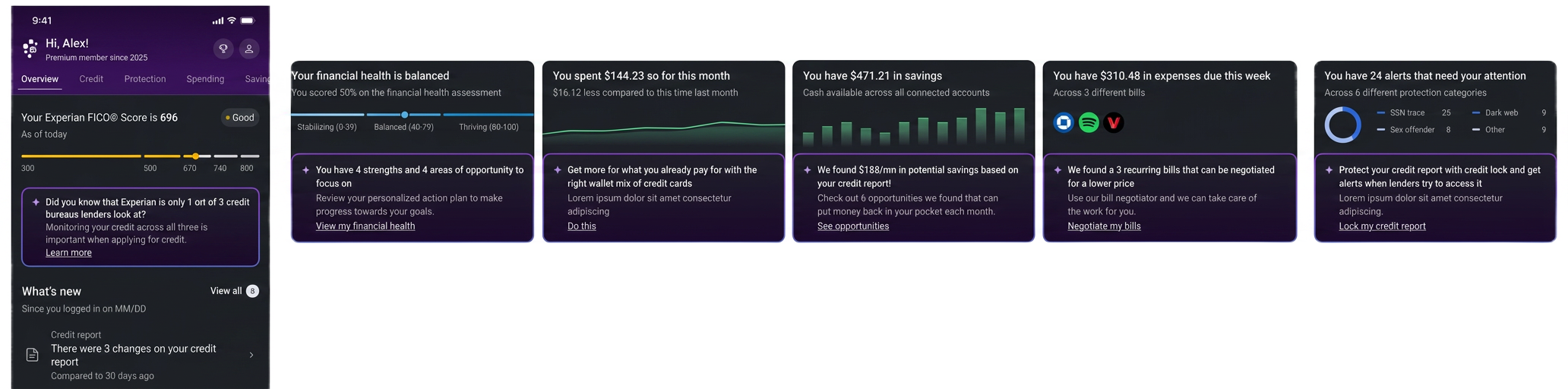
As a result–the homepage became less of a navigation hub and more of a personalized snapshot of someone's financial life.
Prototyping the System with AI
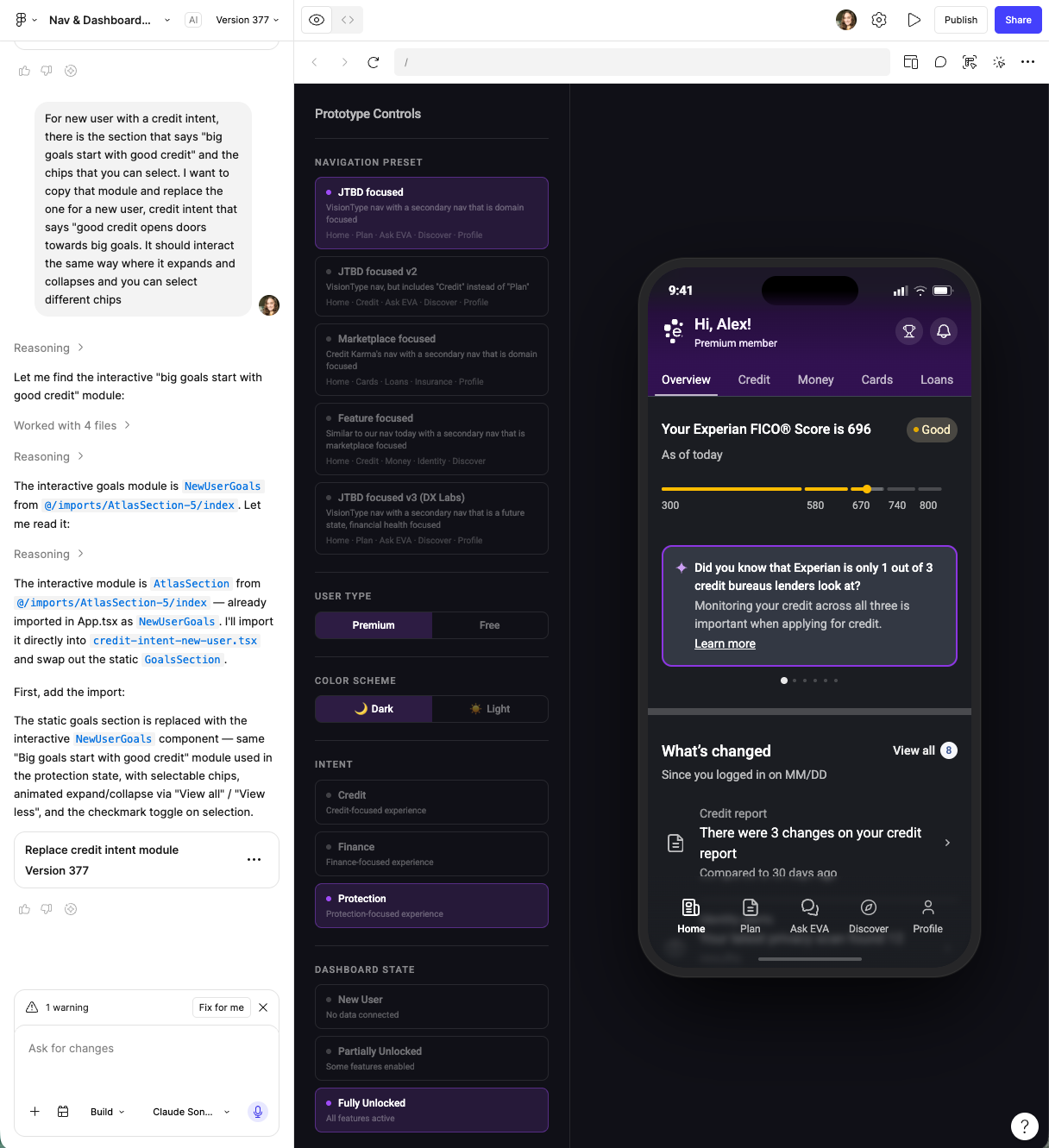
We didn't just prototype the interface.
We prototyped the experience logic.
The vision was inherently dynamic: the dashboard would evolve based on member intent and what they had unlocked over time. Static screens couldn't effectively communicate all of those possibilities.
Using Figma Make and AI, we created an interactive prototype that brought the experience logic to life, allowing stakeholders to explore different combinations of intent—Credit, Finance, or Protection—and progressive states such as unlocking a credit score, connecting an account, or upgrading to premium alerts.
Instead of designing and presenting dozens of static screens, we could prototype the system itself and let people experience how it evolved.
This new AI-enabled workflow dramatically accelerated our ability to make the vision tangible, creating a shared artifact that could be used for internal alignment, rapid iteration, and ultimately user testing.
Designing Beyond the Interface
As we continued to evolve the vision, the work uncovered something unexpected. The experience highlighted deeper organizational and technical challenges around personalization, data architecture, analytics, and platform capabilities.
Rather than designing within those constraints, we used the vision to expose what would need to change for the experience to become possible.
The project became more than a product vision. It became a conversation about how the organization itself would need to evolve.
Outcomes
Although the vision is still evolving, the work has established a shared experience framework that is influencing conversations around personalization, AI, onboarding, and the future member experience.
Elements of the future-state concept have already begun influencing the current product, including a hero carousel of personalized metrics now moving into production.
The next phase is focused on validating our core hypothesis through UXR: that progressively demonstrating the value of sharing personal information can create a more relevant experience, encouraging new users to complete account creation and existing members to return more frequently.
We are also continuing to define the upgrade and subscription experience while partnering with engineering on a proof of concept to uncover the technical and backend capabilities required to make personalized experiences possible at scale.
“This project fundamentally changed how I think about experience strategy. What started as redesigning a homepage and adding new features to an existing experience, evolved into designing a relationship. The most meaningful opportunities rarely begin with a feature request—instead they begin by stepping back, understanding the system as a whole, and helping an organization answer a much bigger question: What kind of relationship are we trying to build with the people we serve?”