PRODUCT DESIGN & EXPERIENCE STRATEGY · 2024–PRESENT
Financial Health
Defining Experian's financial health strategy and creating a path from passive monitoring to proactive, personalized guidance.
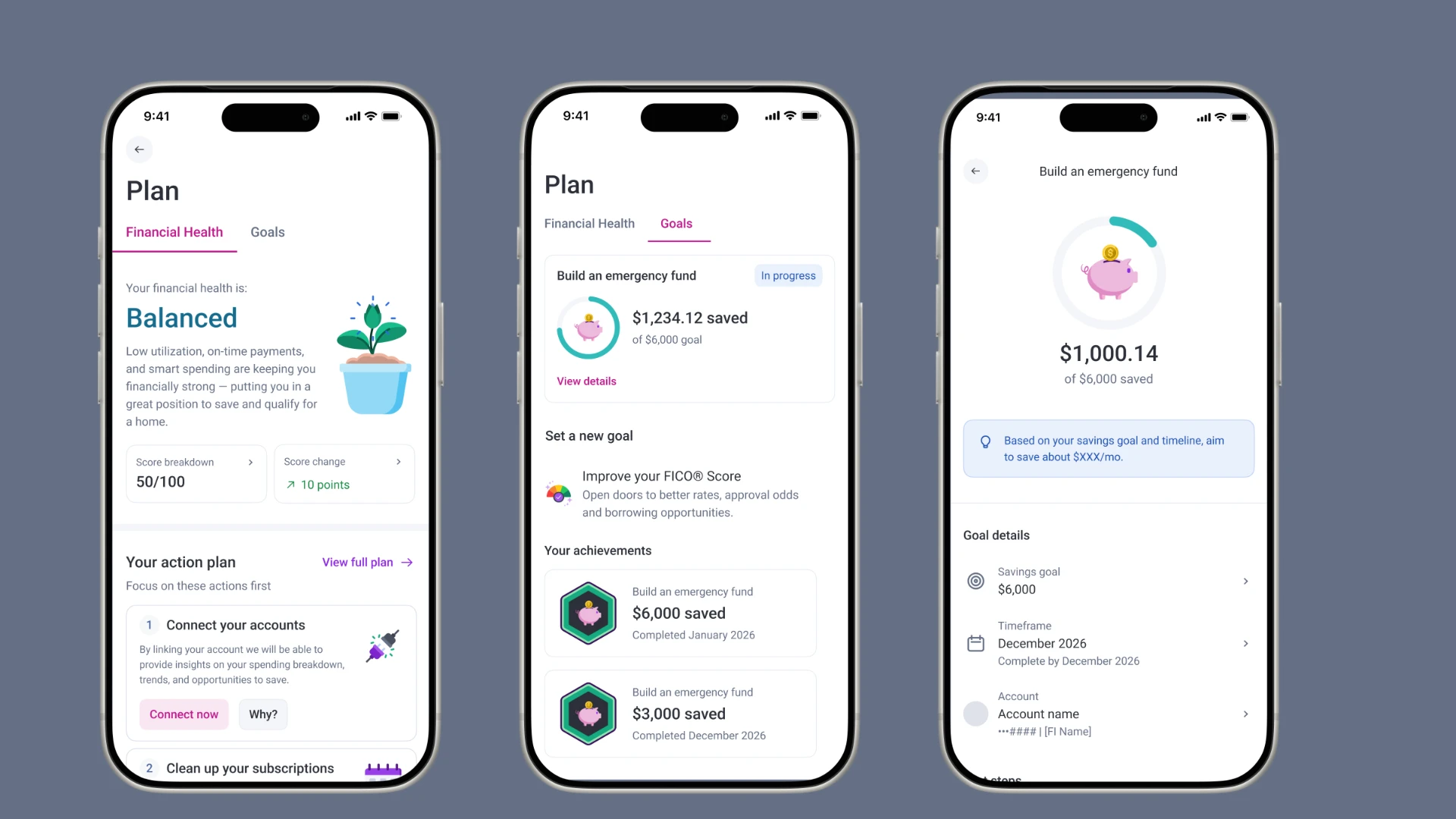
- Role
- Experience Strategy & Product Design
- Year
- 2024–Present
- Focus
- Product Design • Experience Strategy • Cross functional collaboration • Prototyping
- Team
- Design, Product, UXR, Content Strategy, Leadership
The opportunity
We were organized around features. People are organized around their lives.
Experian has an extraordinary amount of financial information about its members—credit reports, financial accounts, identity exposure, monitoring, alerts, and tools across credit, money, and protection.
But the experience was largely organized around those features and categories, while people experience their finances through the context of their lives. They don't wake up thinking “I need to check my credit score.” They're thinking:
“Can I afford a house?”
“Am I financially secure?”
“Am I ready to make this purchase?”
The product could show people what was happening, but it didn't consistently help them understand what it meant for their lives or what to do next.
This created a gap between the richness of the data Experian had and the kind of guidance people actually needed.
My role
When I joined the initiative, early discovery was underway, but there was no shared north star or clear path forward. I helped define a strategy for evolving Financial Health from passive monitoring to proactive, goal-oriented guidance—connecting what we know about a member’s financial life to what they’re trying to accomplish. I brought Design, Product, UXR, Content Strategy, and Leadership together to align on the opportunity, surface assumptions, and identify what we needed to learn. From there, I helped define the north star and create an incremental path from what we could build today toward where we ultimately wanted to go.
Focus areas:
- Experience strategy
- North-star vision
- Cross-functional alignment
- Research synthesis
- Incremental roadmap
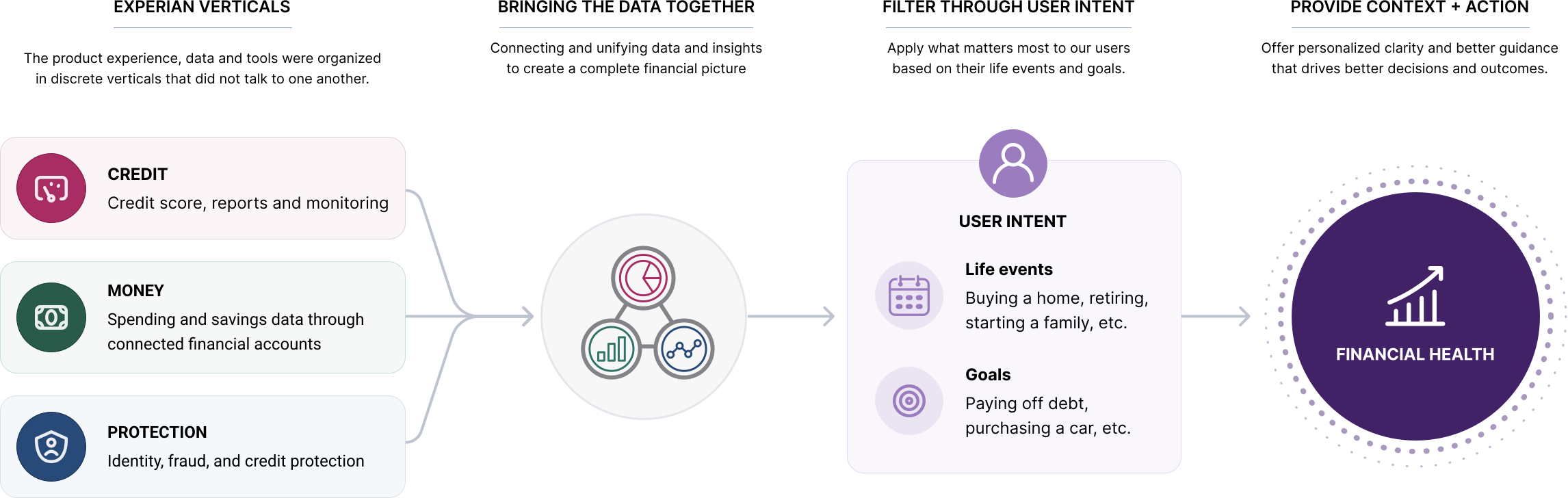
Connecting Experian's data, user intent, and personalized guidance into a unified financial health experience.
What we had / What was missing
What we had
What was missing
Rich financial data
Credit reports, financial accounts, identity exposure, monitoring, alerts, and tools across credit, money, and protection.
A unifying narrative
How all of this information fits together.
Powerful tools
Actionable levers such as Boost, monitoring, alerts, and financial products.
Context
Why something matters to a member right now.
Established infrastructure
Systems capable of surfacing information and notifying members when something changes.
Connection to goals
How financial health relates to what someone wants to accomplish.
Monitoring and alerts
Capabilities for tracking changes and notifying members when something needs attention.
Proactive guidance
What to do next—and whether those actions are actually helping.
The strategic shift
From telling people what is happening to helping them understand what it means.
The opportunity wasn't simply to create another financial feature. It was to rethink the role Experian could play in someone's financial life.
We wanted to move toward an experience that could answer three fundamental questions:
- 1
Where am I today?
Understand my overall financial health.
- 2
What does that mean for me?
Connect my financial state to my goals and priorities.
- 3
What should I do next?
Give me clear, personalized actions that help me move forward.
This meant shifting the experience from
Creating a bridge to the future
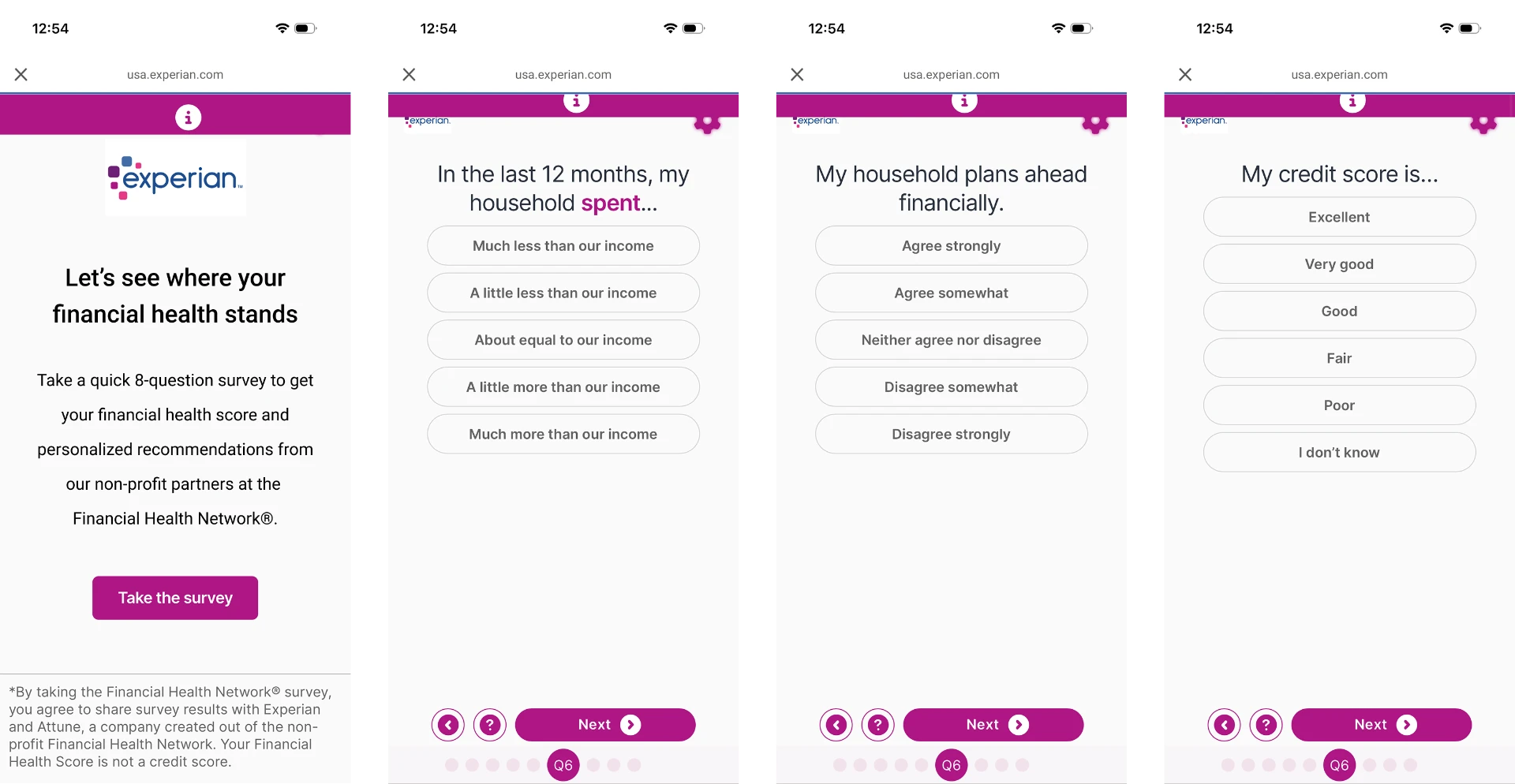
The survey was a bridge, not the destination.
To begin testing the model, we partnered with the Attune Platform, which utilizes the Financial Health Score® diagnostic developed by the Financial Health Network with USC.
The model gave us a way to provide the kind of assessment and guidance we ultimately wanted to create, while requiring members to provide some of the information themselves. The assessment was an eight-question survey for users that generated:
01
Overall Financial Health Score
A simple measure of how the member is doing.
02
Four Financial Health Pillars
Spending · Saving · Borrowing · Planning
03
Areas of Strength & Opportunity
Eight areas identified across four financial health pillars based on the members responses.
04
A Priority Area
One area where the member could focus their attention.
05
Recommended Actions
Clear next steps based on their results.
This created a simple progression
Tell us about yourself
Understand your financial health
Identify what matters most
Take action
The survey was a way to begin testing the value of Financial Health—not the experience we ultimately wanted to create. It helped us learn how people understood their financial health, what information they found useful, and where they needed more interpretation and guidance. Those learnings became inputs into defining the North Star.
The longer-term opportunity was to use what we learned from this model to eventually build an Experian-owned, data-driven approach that could leverage the financial information we already had—reducing the effort required from users while making the experience increasingly personalized.
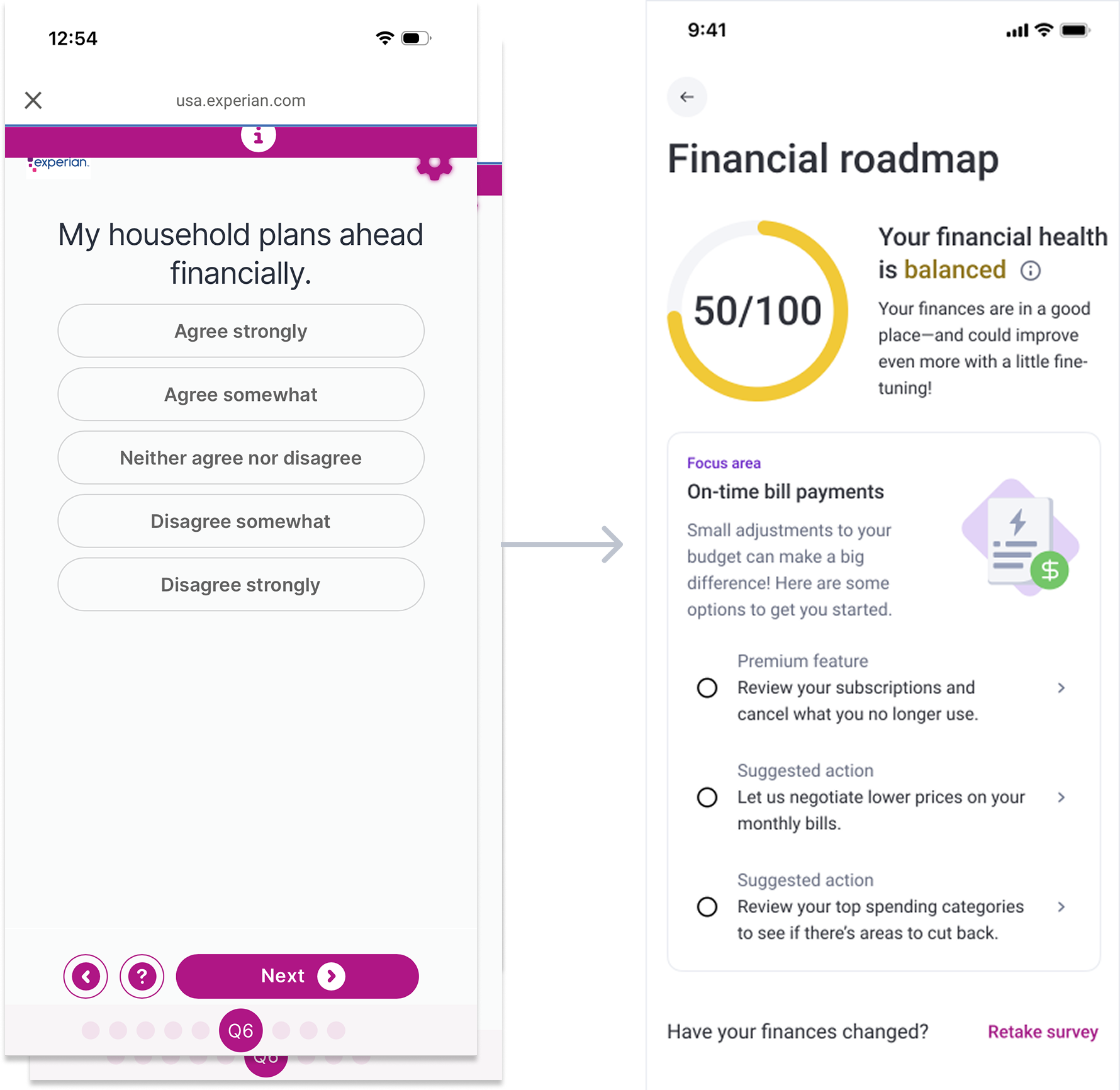
Turning research into strategy
People weren't looking for more financial information. They wanted help making sense of it.
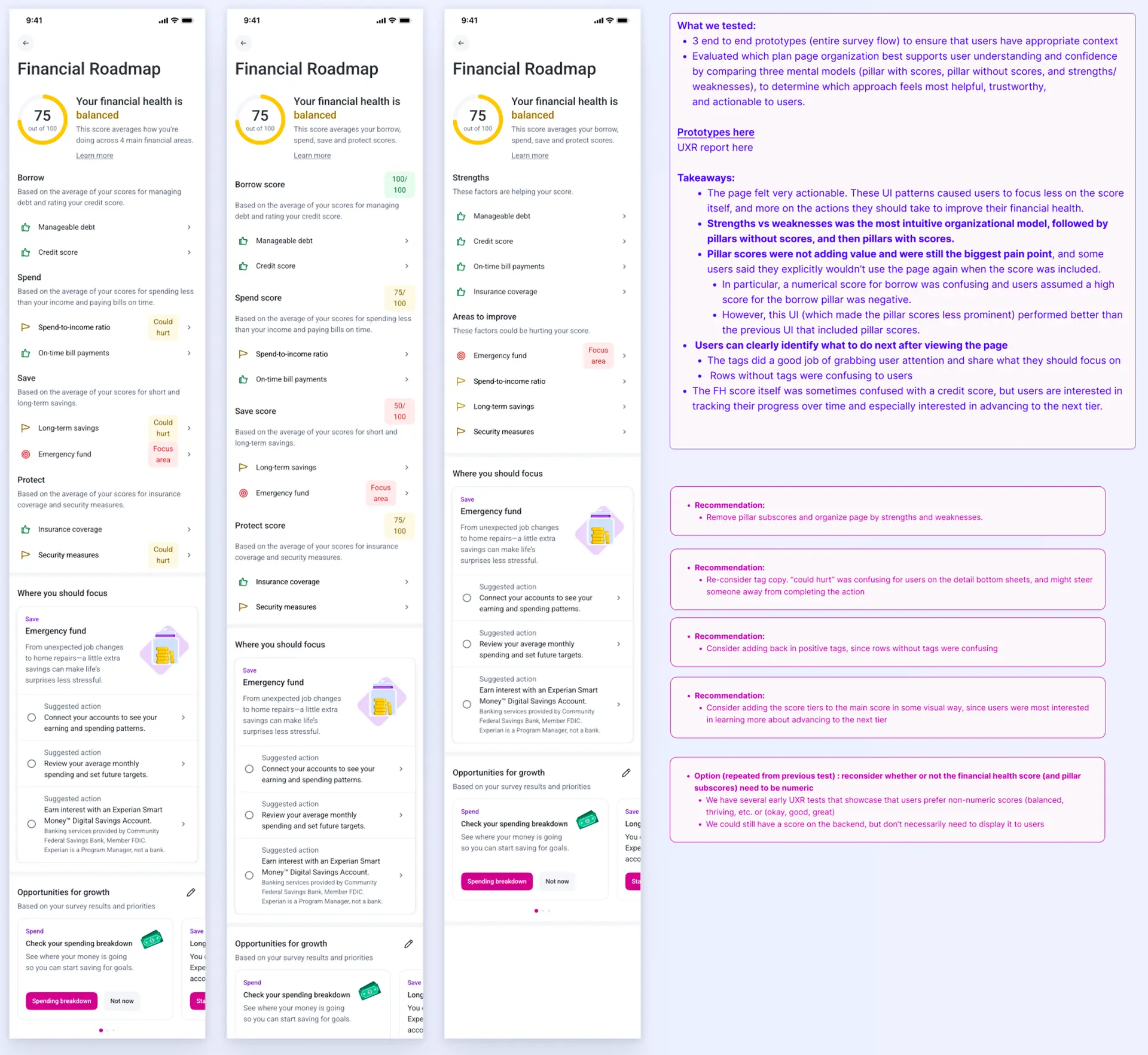
Throughout this initiative, we had ongoing engagement with UXR to consistently test our assumptions. One of the most influential studies we did that shaped the trajectory of this experience was where we tested three ways of organizing the assessment results:
01
Pillar
Identifies strengths and weaknesses for the borrow, spend, save and plan pillar
02
Pillar with pillar scores
Identifies strengths and weaknesses by pillar along with an overall pillar score
03
Strengths vs. opportunities
Highlights all of the users strengths vs. all of their opportunities, irrespective of pillar category
Testing showed users preferred organizing results around strengths and opportunities, finding it more actionable and easier to focus on improvement rather than scores.
STRATEGIC OPPORTUNITY“The value isn't in giving people more data. It's in helping them understand what the data means and what they can do with it.”
Defining the north star
The North Star wasn't a final design. It was a framework for deciding what came next.
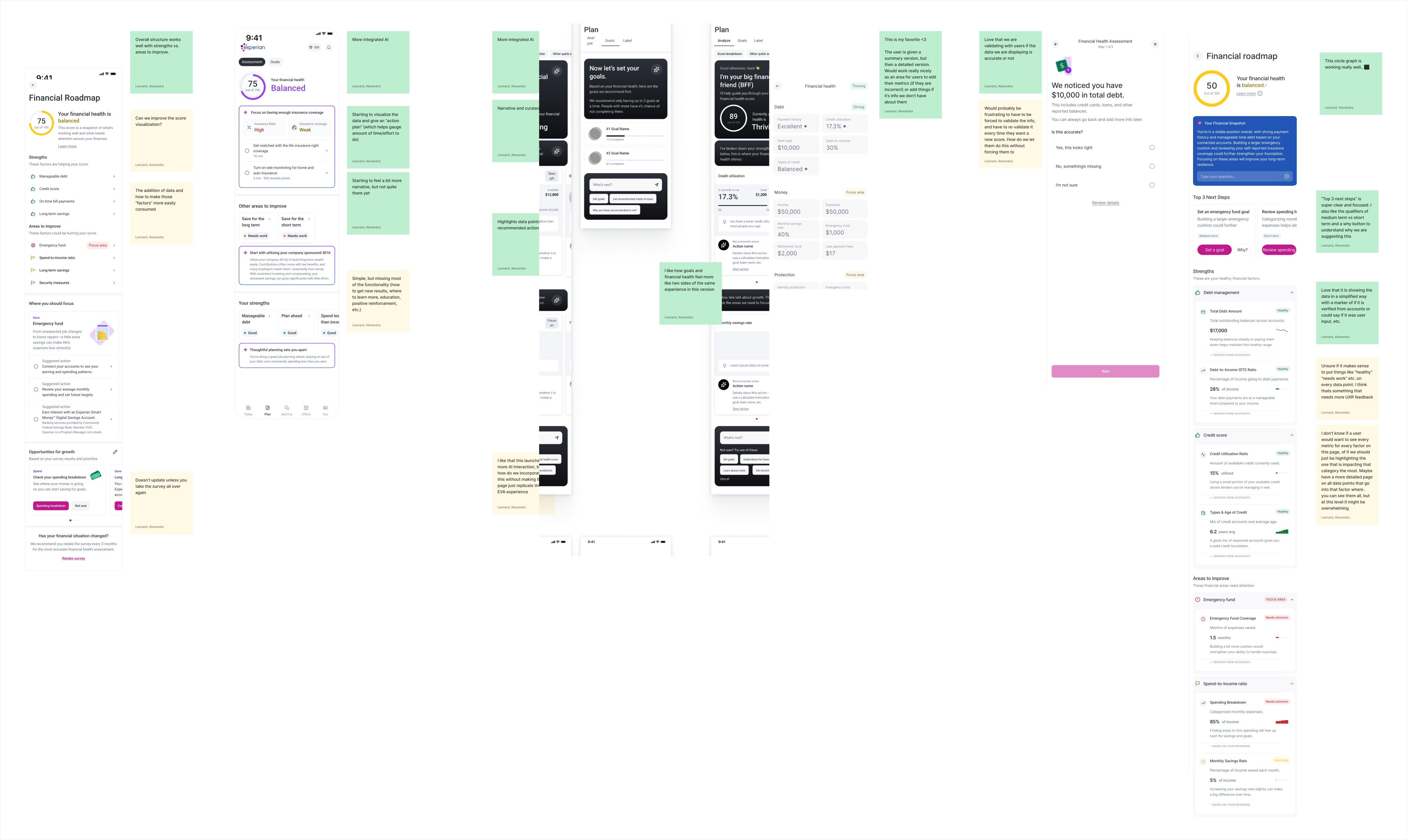
As the team learned from the initial experience, I began synthesizing our research, previous explorations, product constraints, and emerging ideas into a clearer direction for Financial Health.
The goal wasn't to design a polished future-state experience and hand it off. It was to establish a North Star that could help us evaluate ideas, make tradeoffs, and decide what to explore and prioritize next. That North Star centered around a fundamental evolution:
Transform Financial Health from a point-in-time assessment into an evolving financial profile that uses what Experian already knows to proactively help users understand where they stand, prioritize what matters, take action, and make progress toward their goals.
Establishing experience principles
Turning the North Star into a framework for decision-making.
The North Star helped us establish a set of principles that could guide how Financial Health evolved.
EXPERIENCE FRAMEWORK
01
Start with what we know
Use Experian's existing financial data to provide immediate value rather than making a survey the prerequisite for the experience.
02
Learn progressively
Allow members to add, verify, or correct information over time, making their financial profile richer and more accurate without repeatedly starting over.
03
Interpret, don't just score
Shift emphasis from a single number toward helping people understand their strengths, opportunities, and what matters most.
04
Prioritize what matters now
Rather than presenting every opportunity equally, identify the next best step and explain why it matters.
05
Connect financial health to real life
Make recommendations meaningful by connecting them to goals like buying a home, paying down debt, or planning for a family.
06
Create an ongoing relationship
Use changing data, progress, goals, and meaningful alerts to evolve Financial Health from a point-in-time assessment into continuous guidance.
Designing an evolving system
From assessment to action to progress.
We began thinking about Financial Health not as a single feature, but as a system and experience layer across the entire product that could continuously help members understand and improve their financial lives.
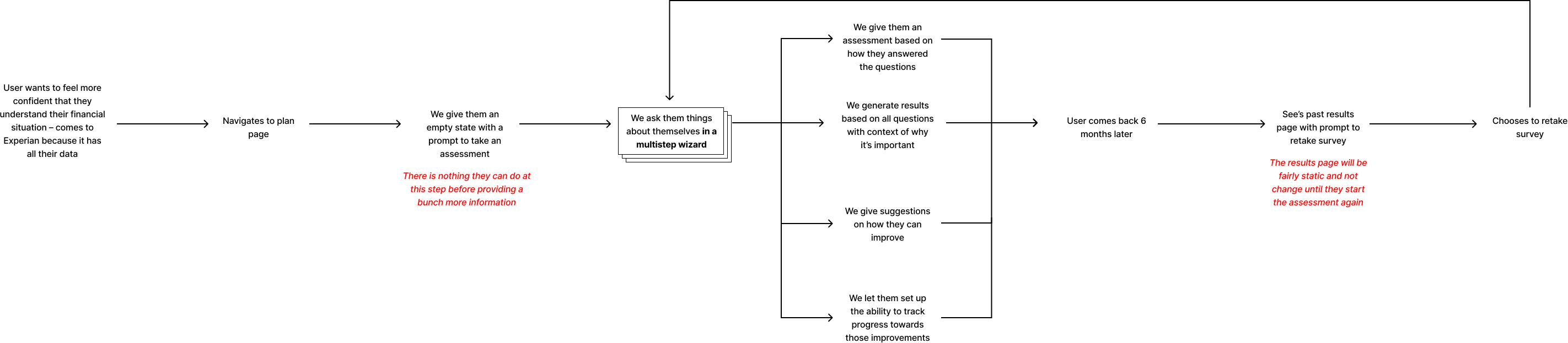
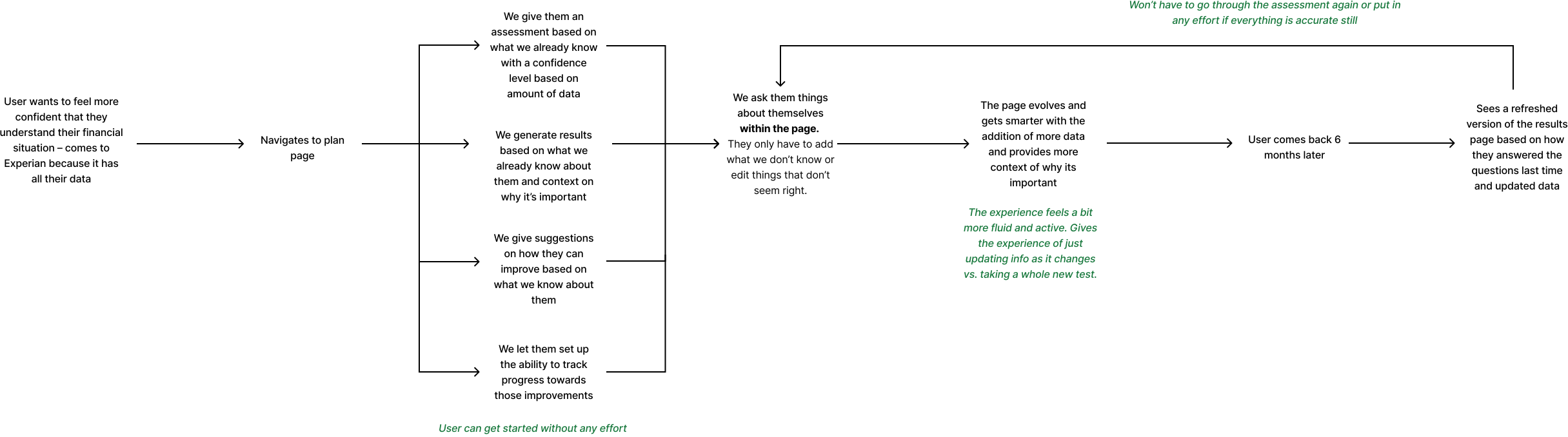
This created a path beyond a one-time assessment. The experience could eventually evolve from helping someone understand their current state to helping them take action, track progress, and make better decisions over time.
Turning the North Star into a roadmap
Future thinking became a tool for prioritizing what we built next.
The North Star gave the team a way to move beyond individual features and evaluate work against a larger experience direction. Rather than attempting to build the entire system at once, we could identify the capabilities required to move toward is incremently.
Several ideas that began as North Star explorations are now becoming concrete roadmap work—including personal-data integration, prioritization, goals, progress tracking, and proactive guidance. The North Star wasn't a prediction of exactly what we would build. It gave us a framework for deciding what to build next.
MVP
Survey-based assessment
Integrate
Use Experian data to reduce user effort
Prioritize
Identify what matters most
Connect
Tie recommendations to goals
Guide
Track progress and proactively surface next steps
“The MVP wasn't the destination. It was a way to start building toward the destination.”
Where the work is today
Financial Health remains an active, evolving initiative. The initial experience demonstrated that connecting financial information to guidance and goals could drive deeper engagement:
- higher engagement among Financial Health users
- 1.5×
- higher engagement among Financial Health users
- higher engagement among users who established a financial goal
- 3×
- higher engagement among users who established a financial goal
We're continuing to iterate on the experience through research, usage data, and product development. Several concepts initially explored through the North Star—including personal-data integration, prioritization, goals, progress tracking, and proactive guidance—are now informing concrete roadmap work.
Reflection
A North Star isn't a final design. It's a tool for making better decisions.
This work reinforced something I've learned repeatedly throughout my career: a North Star is most valuable when it creates direction without pretending we already know every answer.
Our North Star wasn't intended to prescribe the final Financial Health experience. It gave us a way to synthesize what we had learned, establish principles, evaluate new ideas, and connect near-term decisions to a larger experience direction.
The challenge wasn't simply imagining what Financial Health could become. It was creating a framework that helped the organization learn its way toward it.
A North Star shouldn't compete with an MVP. It should give the MVP—and everything that comes after it—direction.